
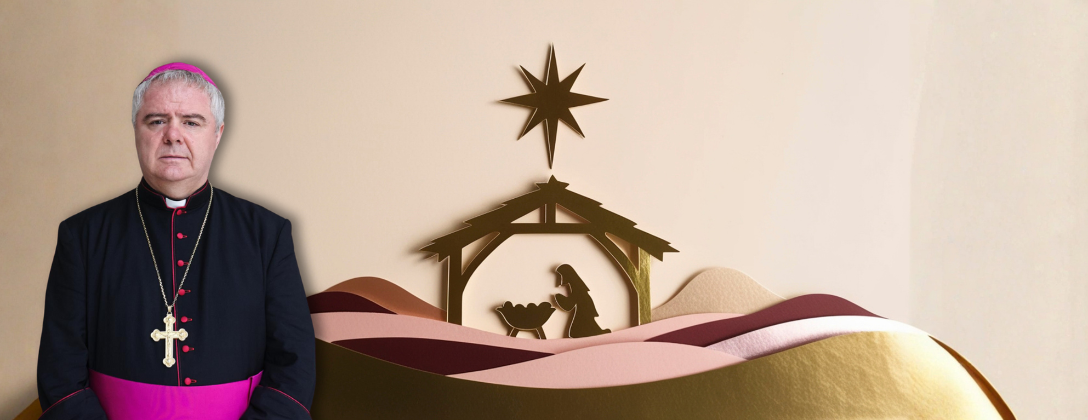
Dear fellow priests, dear consecrated persons, beloved faithful,
During Christmas, there are many inviting scents, but the only scent that brings them all together is the scent of childhood! And who among us does not fondly remember those pleasant years of childhood, those Christmases when, as children, we rejoiced that it was time to celebrate again, that we would go caroling again, that our homes and churches would be dressed in solemn attire again, that we would receive gifts again, that vacation would come again, etc., and all this because Jesus, the Son of God, was born among us, etc. The father of the Little Prince, Antoine de Saint-Exupéry, remembering the Christmases of his childhood, wrote: "When I was a child, the lights on the Christmas tree, the singing at midnight Mass, the tenderness of the smiles were what made the Christmas gifts we received shine." Therefore, along with reviving the memory that Jesus is born among us, Christmas reminds us of childhood, of the fact that we are and must remain children of God, reminding us that the kingdom of heaven belongs to those who are like children.
Christmas is, par excellence, the celebration of childhood, because "a child has been born to us, a son has been given to us," as the prophet Isaiah solemnly proclaims (Is 9:5); because in the manger in Bethlehem, as the angels announce, lies a swaddled child (cf. Lk 2:12) – the newborn King of the universe (cf. Mt 2:2) – before whom the shepherds and magi humbly kneel; because a Virgin – "the blessed Mother of the Redeemer" – lovingly holds the Child in her arms and then offers him to God and the world in the temple as the greatest treasure. Christmas is the feast of childhood because it is the birthday of the Child Jesus, before whom we too kneel in a humble gesture of adoration and prayer, of gratitude and devotion.
Christmas is, par excellence, the celebration of childhood, because "a child has been born to us, a son has been given to us," as the prophet Isaiah solemnly proclaims (Is 9:5); because in the manger in Bethlehem, as the angels announce, lies a swaddled child (cf. Lk 2:12) – the newborn King of the universe (cf. Mt 2:2) – before whom the shepherds and magi humbly kneel; because a Virgin – "the blessed Mother of the Redeemer" – lovingly holds the Child in her arms and then offers him to God and the world in the temple as the greatest treasure. Christmas is the feast of childhood because it is the birthday of the Child Jesus, before whom we too kneel in a humble gesture of adoration and prayer, of gratitude and devotion.
Therefore, the celebration of Christmas, more than any other, reminds us that we must be children, not in the sense of "acting like children," but in the sense of showing that spiritual childhood of which St. Thérèse of the Child Jesus speaks. Being a child means that, no matter what times we live in, no matter what difficulties we encounter along the way, no matter how many and how big the boulders the Evil One throws in our path to the kingdom of God or the storms that shake the boat of our life, one thing is necessary: to trust in the Father, to put our hope in the Son, and in the Holy Spirit to find the source of strength to live serenely like a child. St. Thérèse of the Child Jesus said, "It is trust and nothing else but trust that leads us to Love." Christmas comes with living examples of trust: Mary and Joseph, both trusting in the word of God, and this trust helps them overcome any hardship. Examples of trust are the shepherds, who listen to the angel's word and go to worship the Child; the Magi are also trusting, allowing themselves to be guided by the star and thus coming to adore the great King.
Being a child means, in the logic of the same spiritual childhood, living in love, living in God, for "God is love" (1 John 4:8). A child loves unconditionally; he loves not because his parents give him everything he asks for: he loves them because they gave him life and care for that life with total dedication. The solemnity of the Nativity of Christ reminds us that God also loves us like a child: unconditionally, infinitely; he loves us so much that his Son became flesh to dwell among us (cf. Jn 1:14) and teach us the way of love, not so much through words as through deeds. At the same time, Christmas teaches us that this love is answered with love, with the love of a child, a sign of our gratitude for the life – earthly and eternal – that we have received from God, for his providential care for us, for his Love incarnate in the Child of Bethlehem. St. Teresa of Calcutta said, "Christmas is whenever you allow God to love others through you." Let us therefore love our neighbor, so that through our love, the warmth of divine love may reach him too! Let us be guided by this exhortation of the venerable Tonino Bello: "Let the birth of Jesus make you tired of a selfish, absurd life without spiritual effort, and let it be an opportunity to lead a life full of dedication, prayer, peace, and courage."
Beloved brothers and sisters in the Lord,
The celebration of the Nativity brings us closer to the end of 2025 and the beginning of 2026. Looking back, especially at the Jubilee Year 2025, which will soon come to an end, let us be filled with even more trust, hope, love, and gratitude towards God. It has been a year full of events, both sad and joyful, but, as Job said, "If we accept good from God, should we not also accept evil?" (Job 2:10). We said our physical farewell to Pope Francis this year, who passed away on April 21; but God, through the vote of the cardinals, sent us Pope Leo XIV as our supreme shepherd, elected successor of St. Peter on May 8. In this jubilee year for me—25 years of episcopate—I felt you close to me through the warm words you addressed to me, especially during the Holy Mass on May 24, when we solemnly marked this episcopal jubilee, and through your prayers, for which I am grateful. We lived the Jubilee Year in communion with the entire Universal Church, including through our participation in some jubilee events in Rome, but we also lived it in our local Church on the occasion of diocesan meetings and the patronal feasts of our communities, walking together on the synodal path. For these and all other things, God deserves a big "Thank you!"
I conclude by returning to Jesus' words with which this message opens: "Let the little children come to me" (Lk 18:16), and I urge you to let the Child Jesus come to you, to enter your life, because only he can build in us a child's heart, a heart full of trust and love, making not only Christmas but our whole life full of the fragrance of childhood.
Embracing you all in the Lord Jesus, I wish you a blessed Christmas, rich in heavenly gifts, and a New Year full of faith, hope, and love.
With love,
† Anton CoÈ™a
Bishop of Chișinău
